About us and the boat

About us and the boat:

We were lucky enough to retire early at the start of 2013 so we could head off and "live the dream" on board our Nordhavn 47 Trawler Yacht. The idea is to see some of the planet, at a slow 6 - 7 knots pace. There are no fixed goals or timings, we just had a plan to visit Scotland and then probably the Baltic before heading south.

The idea is to visit the nicer areas in these latitudes before heading south for warmer weather. If we like somewhere, we will stay for a while. If not, we will just move on. So, for the people who love forward planning and targets, this might seem a little relaxed!

If anyone else is contemplating a trawler yacht life, maybe our experiences will be enough to make you think again, or maybe do it sooner then you intended!

The boat is called Rockland and she is built for long distance cruising and a comfortable life on board too. If you want to see more about trawler yachts and the Nordhavn 47 in particular, there is a link to the manufacturers website in our "useful stuff" section. For the technically minded, there is a little info and pictures of the boat and equipment in the same section

Regards

Richard and June

Sunday, 28 August 2022

Dale to Penarth

After a very peaceful night at anchor off Dale, we roused ourselves with tea and breakfast ready for a 7am departure. The sunrise was pretty impressive and tempted us out:


It even made the distant view of the refineries and commercial docks in Milford Haven look more appealing:


although we doubt that the town itself would look any better. Silk purses and all that.

The anchor played a new game on us as we retrieved it, it would not swing the right way around to be recovered onto the rollers despite having the nice swivel in place. This had worked faultlessly before but now the Rocna had a huge amount of mud and stones on it that were altering the balance of the whole anchor. We (ie the captain, it has to be his fault / responsibility) hadn't bothered to rig up the pressure washdown hose so with the aid of a boathook  to swing it round and a very hard-working anchor winch, the Rocna came up together with the mudpack. A clean up job for another day.

Despite leaving at around high water we managed to miss all the commercial traffic and followed the simple route back to Penarth:


It was simple but bumpy. Typically the wind had turned to the east and so we had wind induced waves on the nose. Not stupendously high but they had a very short wavelength meaning the boat pitched up and down nicely. For the non boating folks, short wavelength means that as the boat's bow climbs up and over one wave, it cannot nicely drop down and then rise on the next one. Instead it pretty much lands on top of the next wave, or into the trough of the following one with plenty of up and down motion. The stabilisers take out any roll being induced but you have to live with the pitching which also slows your speed over the ground significantly.

The good news was that as we got into deeper water the wavelength increased a little and plenty of dolphins came to play. Grabbing the camera and trying to take pictures proved tricky as you will see. On this occasion we were too late to capture the guy in the middle of the picture who had dived again but purely by chance got another one in mid air off to the right: 


When we saw several breaking the water together, somehow Simon's head got into the shot as well:


We didn't want to Photoshop these to clean them up - you just get the raw images from the camera so you can laugh at our rather feeble efforts to capture the elegant dolphins.

There was considerable discussion between the folks on board about our ETA at the Cardiff Bay barrage. Thanks to the low rainfall, the bay was only allowing one lock-in per hour and we were aiming for the 8:45pm timeslot. The bumpy time early on had robbed us of quite a bit of speed - the rough calculations and the more scientific one from the navigation PC suggested we were going to miss our planned timeslot. There were two choices really. One was to cram on a bit more power and drive the boat above the economical speed that the hull likes (again, for non boating folks have a look at the internet for information on hull speed or Froude numbers) . The other was to time things to arrive for the lock an hour later. Option two was binned as we wanted to get Simon back to his better half as it was her birthday so we donated some extra diesel to deliver him on time.

Running at 1800 rpm we made up the time nicely and arrived with many other craft for the lock-in. Luckily the first lock was already full and we were the first boat into an empty second lock so we could go starboard side to, our "easy" side. A little LM yacht came in alongside us and Simon recognised it as one he had surveyed previously and so started chatting to the new owners. Proper busman's holiday for him. He even got some more survey work whilst chatting in the lock!

We happily returned to our berth in Penarth although thanks to the low water levels in the bay, it was not easy. The boat handled as though it was moving through glue once inside the marina, getting well and truly "grabbed" by the weed and the effect of the very shallow water.

The trip was about 13.5 hours overall, calmer later on and felt more like a delivery trip than a pleasure cruise. The Bristol channel is not the greatest cruising area but a necessary thing as it takes us to an ideal winter berth location.

Winding down that evening, we saw an article in a sailing magazine talking about the areas around the UK where the tides and geography conspire to make some really rough seas, called races.  Here is their graphic:
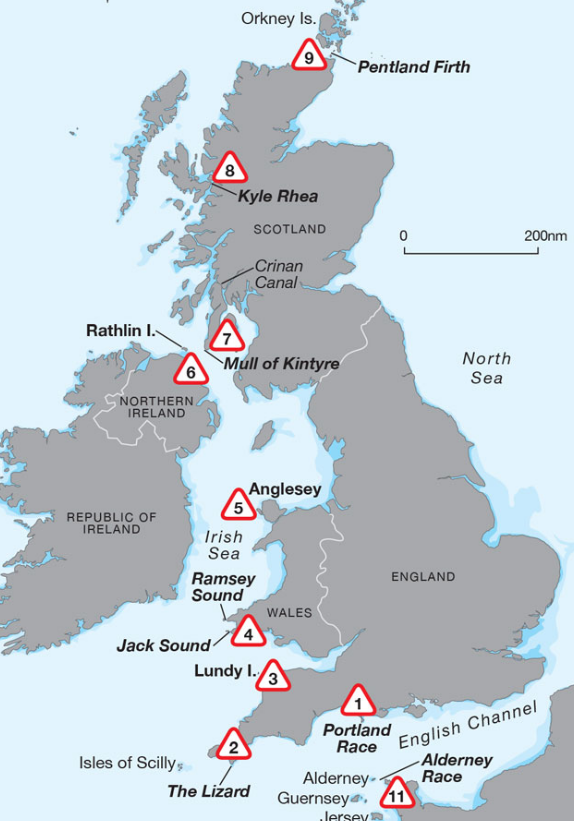


and for anyone interested, here is a link to their article Yachting monthly. Basically, we went through 4 of them during the trip this summer on the way north but only 2 on the way back. You can work it out if you are very bored. The Lizard and Portland were last summer,

Overall, despite the grim weather up north, we put on about 212 main engine hours and covered around 1450 nautical miles (1670 land miles). Because the weather was so bad, we did a lot less "anchoring off" than we wanted and so the genset had a gentle summer - only 30 hours. Poor ignored thing. It will be busier this winter as it gets used on washing days!

Saturday, 27 August 2022

Bangor to Dale (Milford Haven)

With our extra crew member on board, we did a little planning for a departure down the Irish Sea. Leaving Bangor around low water gives you great tidal help heading south for nearly 12 hours but at our speed it then gets you to St David's head (where the tides run very strongly) a little too early. Our compromise, backed up by the planning tool in the Time Zero software was to head off about an hour and a half later. A 7 am departure isn't too bad, although we're not keen on breakfast at 6.15am.

Heading south, Simon looked very "at home" helming once we had negotiated the Donaghadee sound where the tidal flows make course keeping rather challenging:


The weather forecast said light winds early on and they were not kidding - which was good as we were heading into them initially.:  


4.3 knots is a rounding error really. The boat pottered along at the standard cruise speed of 1475 rpm with little fuss as we tracked down the coast:


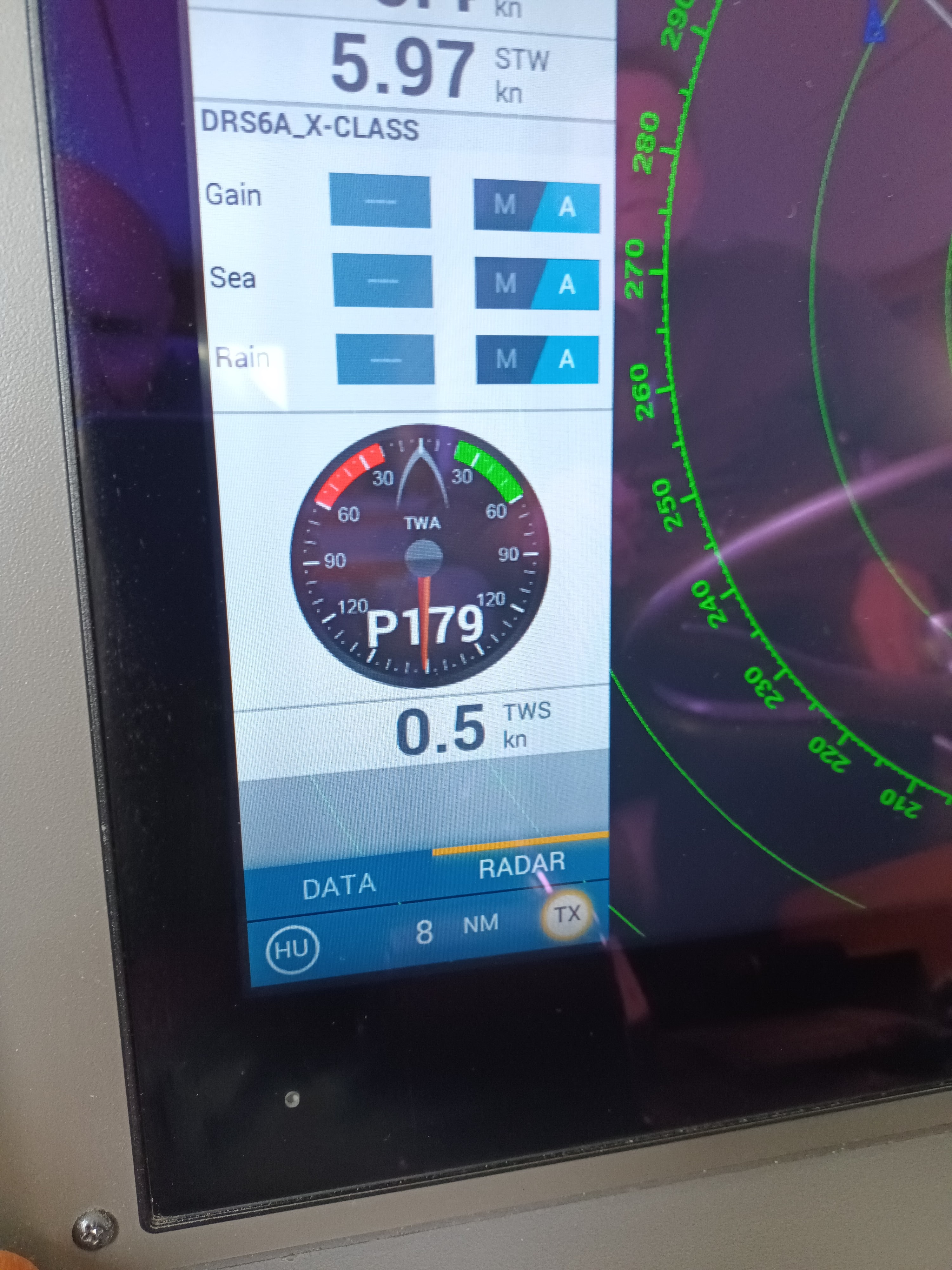
and again as forecast, the wind swung to be astern of us with a wild speed of half a knot:


Things were pretty uneventful.  Simon was learning how the Furuno kit and autopilot worked but we had no need for the stabilisers so that lesson had to wait a little. As night fell and we approached the Dublin area, so the fishing boats came out en masse. Several of them were doing the usual thing of "no AIS" so we relied on the radar to spot and track them. You can see that things were a touch busy:


Simon managed an amazing number of hours at the helm, only taking comfort breaks during the day and two "sleep breaks" overnight. We are not sure if it was excitement, terror, strange substances or a lack of trust in having the captain or crew at the helm that kept him going so effectively.  No matter, it did allow the crew to rest her back and help her recuperation.

The radar picked up one strange target and tracked it. Slow moving, we passed close enough to be able to see the navigation lights - only there were none. Then a yacht that was following us went incredibly close to it:


If the yacht (green triangle) also had radar then they ought to have spotted the"object". Plenty of speculation happened at crew changeover time, the top offerings being a surfacing submarine or a "lost container" floating about. It was a very clear radar target which ARPA happily tracked (the circle and number 31 on the image above) so the yacht had a narrow escape indeed.

Dawn was pretty but only witnessed and photographed by the crew. The captain and Simon were catching up on sleep a little:


You can see that once you clear the most easterly part of Northern Ireland, the route is pretty much due south in one long straight line of about 154 nautical miles: This is how Marinetraffic tracked us:


We had the fun of some dolphins to watch, plenty of seabirds and the radio to keep us company. Mind you, the news was terminally depressing hence it got switched off so as not to spoil the rather good mood on board. Heading towards St David's head, a fresher northerly wind picked up as they forecast and kicked up some bigger following waves. Only a metre and a half with the occasional one up to around 2 metres so the stabilisers started to earn their passage.

We felt that we should take the obligatory lighthouse picture as we passed the Bishop rocks:


mainly to show what a nice day it was really. The tide duly turned to help us (we had been down to about 3.3 knots over the ground) and we made good progress across the bay towards Milford Haven. You can see from the MarineTriffic plot that our AIS signal was not picked up until we were close to the islands (Skomer and Skokholm) so they just extrapolated it with dots. We doubt that our actual course was that straight:


and you cannot blame Simon for any wiggles that did happen - the autopilot was in charge and fighting with the stabilisers for directional control 

Passing between the two islands the tide really wants to carry you south so we were steering a course that was 30 degrees different to our actual track over the ground. It was rather a shock to see yachts and other motor boats again who were out enjoying the nice weather from the moorings / marinas in the Milford Haven area. As we headed into the harbour and the captain was busy preparing the anchor for action, we were spotted and photographed by the folks we know on Allegro, a yacht that berths in Neyland:


Our pictures of their yacht are way less exciting as they had to be taken into the sun:


Still, we tried.....

We headed up to the northern part of the bay off Dale and dropped the anchor in about 6 meters of water, knowing another 4 were coming and that we would lose 2 of the 6 when we hit low water, Engine off and a little relaxation after 32.5  hours or so underway. Dinner was a splendid steak courtesy of the farm shop in Northern Ireland as we felt that we had earned it.. Wish we could go back and buy some more, it was that good. The anchor light cooperated this time and we settled down to catch up on sleep a little. 


Maintenance news:

There isn't any, sorry. The main engine and the electronics all behaved perfectly unlike the occupants of the boat. We didn't even manage to blow a navigation bulb.